Computer Systems Performance Evaluation and Prediction

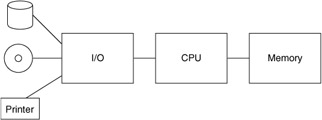
To continue our earlier discussion of computer configurations we will examine how the various components can be interconnected to form a computer system. The basic premise of these architectures is to speed up the movement of data to allow for increased processing. The basic architecture has the CPU at the core with a main memory and input/output system on either side of the CPU (see Figure 2.12). In this architecture all data flows into, out of, and through the CPU under the control of the CPU. This represents the basic von Neumann architecture described earlier. Refinements of this architecture have been designed to remove the CPU from the burden of controlling all data movement.
To remove the CPU from the central function of coordinating all data flow the central input/output controller architecture was developed (see Figure 2.13). This architecture has the IOC at the core of the system with the CPU, main memory, and I/O devices connected to the IOC hub. To transfer data from the main memory to an I/O device the CPU would command the IOC to initiate the transfer. The data would flow under control of the IOC from the main memory through the IOC to the named output device. The problem with this architecture is that the CPU must also use the IOC to transfer data from the main memory to the CPU. This results in potential reduction in CPU performance. Variations of...