Computer Telephony Encyclopedia
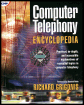
Detailed, no-nonsense and indispensable particulars of computer telephony.
 TABLE OF CONTENTS
 The ECTF (See Enterprise Computer Telephony Forum) specifies software interfaces used throughout their vision of a computer telephony architectural model based upon open, shared resource servers. The foundation for the ECTF s software standards is the S.100 media- and switching-services API that allows resources to be shared in CT servers. For client/server systems, the ECTF s S.200 media-services transport-protocol interface provides client intercommunication with the server. If a manufacturer happens to supply a product that encompasses both a client and server, it is not restricted to using S.200 but can instead use its own proprietary protocol. The ECTF s S.300 service-provider interface permits the telephony server to interchangeably use resources from different vendors as they work together in sharing CT resources.. The S.900 administrative-services interface includes functionality for managing the server s configuration, faults, performance, security, and accounting.
The S Series software standards are said to complement, rather than replace, existing call control API standards, such as Microsoft s Telephony Application Programming Interface (TAPI) and Novell s Telephony Services Application Programming Interface (TSAPI), the Computer Supported Telephony Application (CSTA), IBM s CallPath or the Javatel Applications Programming Interface (JTAPI).
S.100 is the software foundation for the ECTF s (See Enterprise Computer Telephony Forum) Framework for creating a CT computer that processes audio, fax, image and other media transmitted over phone calls and makes those media usefully accessible (interactive voice / fax response) and manageable (voice mail, fax servers, unified messaging, etc.).
It consists of openly defined, modular hardware- and-software elements including multi-vendor /...