Engineering Global E-Commerce Sites

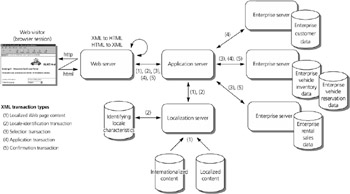
The SLKD Auto Rental example relies upon HTML-based Web forms to capture data. Combinations of predefined drop-down lists, form field entry, and checkboxes are used for capturing data. The processing of an HTML Web form inserts captured content into an HTTP transaction that is submitted to the receiving Web server. Depending upon the architecture layering of the Web site, the Web server may perform minimal validation, reformat or transform the element content of the forms into a transaction, and pass the transaction on to one or more application servers. In order to address performance and volumetrics, other architecture alternatives may avoid any processing or logic by the Web server and place the reformatting of form content as transactions in an application server. If localized content will be returned to the browser, the application server may also exchange transaction data with one or more localization servers. Depending upon the purpose of the transaction and the architecture of the Web site, the application servers then pass the transactions to one or more enterprise application servers (see Figure 5.5).
Of importance is the movement and exchange of data between servers. From a global enterprise perspective, this data movement will result in processing by traditional enterprise applications and the integration of globally diverse Web data with traditional enterprise data. This implies the need for highly standardized, flexible, and reusable transactions that are described by enterprise transaction schemas (i.e., vocabularies). If a set of common...