Engineering Global E-Commerce Sites

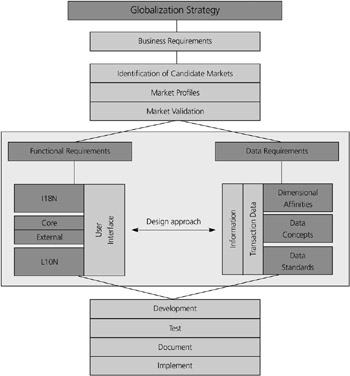
Following market validation, a key activity takes place where the business requirements and market profiles are combined and extended to identify both functional requirements and data requirements. Functional requirements drive the internationalization and localization processes and, more specifically, interface design. Data requirements identify necessary global data concepts and applicable data standards. As these activities progress toward Web site engineering activities, the globalization process will align and integrate the different designs (see Figure 5.2).
Rather than focus exclusively on presentation, language, and cultural personalization, or on data and transaction structures, the globalization process will combine the designs. A Web site that has been engineered using a combined design approach will be more apt to attract and capture customers from the international target markets, facilitate the development of global customer relationships, and integrate data in order to fulfill orders and service customers.
Initially, functional requirements and data requirements will tend to diverge. To split the functional requirements from the data requirements, the project team must consider the fundamental purpose behind the two activities. Functional requirements are primarily focused on attracting and capturing the target audience. Data requirements are focused on the effective capture, processing, and integration of globally diverse data and e-commerce transactions.
As previously described, internationalization and localization tend to focus on cultural and language presentation characteristics. Internationalization takes into account the Web site processes, navigation, flow, and content that are common to all supported...