Engineering Rock Mechanics: An Introduction to the Principles

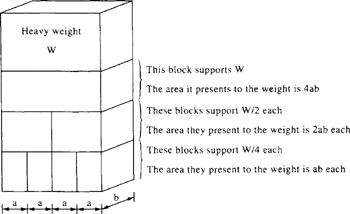
We do not talk about internal forces when we are dealing with solid bodies, we refer to stresses instead. The reason is simple. Consider a stack of concrete blocks of different sizes supporting a heavy weight.

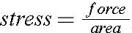
As we can see, when the size of the solid body being considered changes, so the force changes. But if we use stress, defined as
then we can see that in the example above each block is subject to a stress of W/4 ab-stress is independent of block size. Hence, if we were to divide a solid body into elements , providing we work in terms of stresses the size of the individual elements will not affect the stress values.
Stress is a property that needs three values to fully describe it in the two-dimensional case: the magnitude of the force, the direction of the force and the area it acts on.
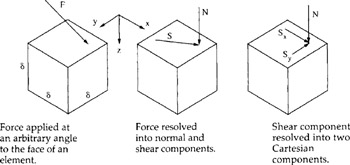
It is known as a tensor property, cf. scalars with one value and vectors with two. Stress analysis is only possible if we work in components, like this:

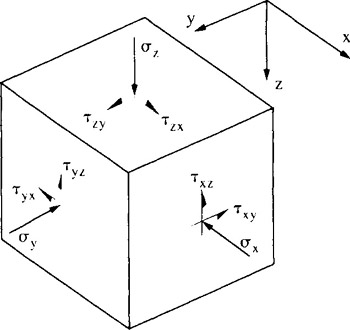
After we have resolved the force into three Cartesian components, we can define the associated stresses, and not before. In this example we have
and in general we have:
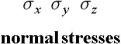
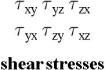
act normal to face

act along a face, parallel to an edge of the element.
Only the stresses on the visible faces have been shown here
This is the geomechanics, or compression-positive, convention for right-handed axes.
Remember the notation: