Engineering Rock Mechanics: An Introduction to the Principles

Appendix B: Hemispherical Projection

Hemispherical Projection Methods

These methods enable three-dimensional orientation data to be displayed in two dimensions and manipulated graphically.

Fundamental Geometry

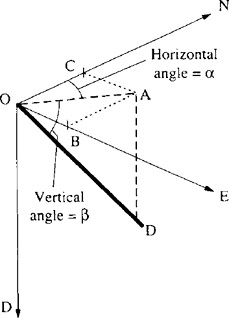
Directions are vectors with unit length. We assume that these vectors emanate from the origin of a Cartesian co-ordinate system. It is convenient to use east/north/down for rock mechanics.

Directions are measured in terms of the angles

? = trend

? = plunge

? is measured with a compass, ? is measured with a clinometer.

Note that OB = sin ? cos ?

OC = cos ? cos ?

AD = sin ?

Because every vector has unit length, the tips lie on the surface of a sphere. We are usually only interested in downward-directed vectors, lying on the lower hemisphere.

Projection Onto Two Dimensions

One way to form a two-dimensional plot associated with vectors on the lower hemisphere is to project the tips of the vectors onto the horizontal plane that passes through the origin (i.e. the centre of the sphere), assuming the point of projection is the North Pole of the sphere:

All points on the lower hemisphere can be projected in this way. This type of projection is called equal angle projection and is used exclusively in rock mechanics for engineering.

Equal Angle Projection of a Plane: Great Circles

We regularly use planes in rock mechanics analyses and so it is important to determine the projection of such features.

The mathematics of the projection are...

UNLIMITED FREE
ACCESS
TO THE WORLD'S BEST IDEAS

SUBMIT
Already a GlobalSpec user? Log in.

This is embarrasing...

An error occurred while processing the form. Please try again in a few minutes.

Customize Your GlobalSpec Experience

Category: Fresnel Lenses
Finish!
Privacy Policy

This is embarrasing...

An error occurred while processing the form. Please try again in a few minutes.