Engineering, Business and Professional Ethics
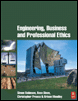
With practical case studies and examples throughout, this book highlights the ethical dimension of engineering while showing how values and responsibility relate to everyday practice.
 TABLE OF CONTENTS
 While many definitions exist, as noted in Chapter 5, CSR looks at the socially responsible way companies relate to their stakeholders, across a whole dimension of activities. The essence is that companies behave in a responsible manner beyond their commercial and regulatory requirements. The CSR concept is closely allied to the emergence of the concept of 'corporate citizenship', which Andriof and McIntosh (2001) described as 'understanding and managing a company's wider influences on society for the benefit of the company and society as a whole'. The corporate citizenship approach takes the view that companies, as independent legal entities, are members of society and as such can be regarded as citizens with legal rights and duties. Accompanying these rights and duties is an expectation to act as good corporate citizens and contribute to the well-being of society more generally. While CSR is seen as an external-facing concept focusing on external relations, corporate citizenship requires the creation of internal structure perspectives before dealing with external relationships. Good corporate citizenship is a part of every facet of the organization.
Corporate social responsibility is also linked to other concepts such as social cohesion and social capital. Conceptually, CSR is primarily associated with voluntary integration of social and environmental concerns in organizational strategy. However, there is a growing recognition of the importance of business in developing social cohesion and helping overcome societal problems. The stakeholder concept is critical to the role organizations play in developing social capital. Dialogue with various stakeholders helps develop this...