Flight Testing of Fixed-Wing Aircraft

Chapter 9: Level Flight Performance Flight Test and Data Reduction Methods for Propeller-Driven Aircraft

9.1 Introduction

There are a number of methods for level flight performance data reduction for propeller-driven airplanes. Most of these methods have problems with determining full throttle performance under standard conditions and are not readily useable for determining airplane drag coefficients. The method we will discuss here solves both of these problems. This method is called the PIW-VIW method.

9.2 Federal Aviation Administration Requirements

There are no FAA requirements for level flight performance. However, some of the acceptable methods for FAA climb performance require the use of parameters derived from the airplane drag polar which is obtained from level flight performance.

9.3 PIW-VIW Method

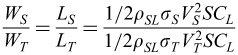
The PIW-VIW1 method is derived by making the power required curve a single curve good for all air densities and airplane weights. To accomplish this we will make two assumptions. The first assumption is that at a given angle of attack both the lift coefficient C L and the drag coefficient C D are constant. When we assume that the angle of attack is the same for two different conditions of weight and altitude we can equate these two conditions through the following:

(9.1)

where

subscript S

= standard conditions

subscript T

= test conditions

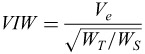
If we cancel like terms through division and solve for the standard airspeed ( V S) which we will call VIW, and replace the true airspeed V T and with equivalent airspeed V e we have:

(9.2)

The equivalent airspeed can be replaced by calibrated...

UNLIMITED FREE
ACCESS
TO THE WORLD'S BEST IDEAS

SUBMIT
Already a GlobalSpec user? Log in.

This is embarrasing...

An error occurred while processing the form. Please try again in a few minutes.

Customize Your GlobalSpec Experience

Category: Flight Displays
Finish!
Privacy Policy

This is embarrasing...

An error occurred while processing the form. Please try again in a few minutes.