Flight Testing of Fixed-Wing Aircraft

The level flight performance tests of jet-powered aircraft serve the same function as those for propeller-driven aircraft. The primary purpose for conducting these tests is to provide cruise data for the "Pilot's Operating Handbook" or flight manual. However, there are several other reasons that we may wish to conduct these tests; they are:
to assure design specifications are met
to determine the airplane drag polar
to determine engine characteristics in flight
to determine drag increments of small changes during development testing
The flight test techniques and theory of level flight performance tests of jet aircraft are similar in some respects to those for propeller-driven aircraft, but there are also some important differences. First let us examine the theory behind the level flight performance of a jet aircraft.
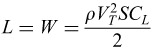
If we start with the condition of steady state level flight where lift equals weight we can say:
| (10.1) | |
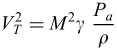
If we also consider that V T = Ma, and that a = ? ?P a/ ?, then we can write:
| (10.2) | |
where
| M | = Mach number |
| P a | = the ambient pressure |
| ? | = specific heat ratio for air |
| a | = the speed of sound |
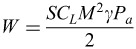
By substitution:
| (10.3) | |
If we multiply Eq. (10.3) by p SL/p SL and substitute the pressure ratio ? for P a/P SL, then Eq. (10.3) becomes:
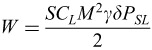
| (10.4) | |
and by rearranging we have:
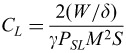
| (10.5) | |
For a given aircraft and set of conditions,