Fundamentals of Power Electronics, Second Edition

It is nearly always required that a filter be added at the power input of a switching converter. By attenuating the switching harmonics that are present in the converter input current waveform, the input filter allows compliance with regulations that limit conducted electromagnetic interference (EMI). The input filter can also protect the converter and its load from transients that appear in the input voltage v g( t), thereby improving the systemreliability.
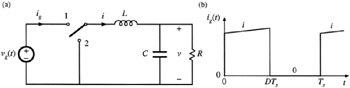
A simple buck converter example is illustrated in Fig. 10.1. The converter injects the pulsating current i g( t) of Fig. 10.1(b) into the power source v g( t). The Fourier series of i g( t) contains harmonics at multiples of the switching frequency f s, as follows:
| (10.1) | |
In practice, the magnitudes of the higher-order harmonics can also be significantly affected by the current spike caused by diode reverse recovery, and also by the finite slopes of the switching transitions. The large high-frequency current harmonics of i g( t) can interfere with television and radio reception, and can disrupt the operation of nearby electronic equipment. In consequence, regulations and standards exist that limit the amplitudes of the harmonic currents injected by a switching converter into its power source [1 8]. As an example, if the dc inductor current i of Fig. 10.2 has a magnitude of...