Fundamentals of Power Electronics, Second Edition

Part III: Magnetics

CHAPTER LIST

Chapter 13: Basic Magnetics Theory
Chapter 14: Inductor Designs
Chapter 15: Transformer Design

OVERVIEW

Magnetics are an integral part of every switching converter. Often, the design of the magnetic devices cannot be isolated from the converter design. The power electronics engineer must not only model and design the converter, but must model and design the magnetics as well. Modeling and design of magnetics for switching converters is the topic of Part III of this book.

In this chapter, basic magnetics theory is reviewed, including magnetic circuits, inductor modeling, and transformer modeling [1 5]. Loss mechanisms in magnetic devices are described. Winding eddy currents and the proximity effect, a significant loss mechanism in high-current high-frequency windings, are explained in detail [6 11]. Inductor design is introduced in Chapter 14, and transformer design is covered in Chapter 15.

13.1 REVIEW OF BASIC MAGNETICS

13.1.1 Basic Relationships

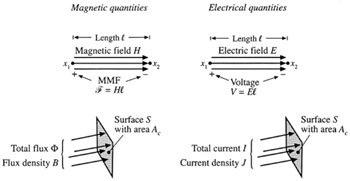
The basic magnetic quantities are illustrated in Fig. 13.1. Also illustrated are the analogous, and perhaps more familiar, electrical quantities. The magnetomotive force , or scalar potential, between two points x 1 and x 2 is given by the integral of the magnetic field H along a path connecting the points:

(13.1)

Figure 13.1: Comparison of magnetic held H. MMF ?, flux , and flux density B, with the analogous electrical quantities E, V, I, and J.

where d ? is a vector length element pointing in the direction of the path. The dot product...

UNLIMITED FREE
ACCESS
TO THE WORLD'S BEST IDEAS

SUBMIT
Already a GlobalSpec user? Log in.

This is embarrasing...

An error occurred while processing the form. Please try again in a few minutes.

Customize Your GlobalSpec Experience

Category: Transformer Winding Services
Finish!
Privacy Policy

This is embarrasing...

An error occurred while processing the form. Please try again in a few minutes.