Fundamentals of Power Electronics, Second Edition

The waveforms encountered in power electronics converters can be quite complex, containing modulation at the switching frequency and often also at the ac line frequency. During converter design, it is often necessary to compute the rms values of such waveforms. In this appendix, several useful formulas and tables are developed which allow these rms values to be quickly determined.
RMS values of the doubly-modulated waveforms encountered in PWM rectifier circuits are discussed in Section 18.5.
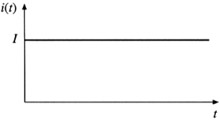
DC, Fig. A.1:
| (A.1) | |
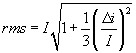
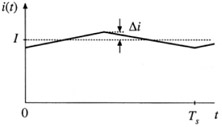
DC plus linear ripple, Fig. A.2:
| (A.2) | |
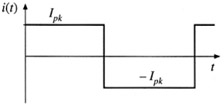
Square wave, Fig. A.3:
| (A.3) | |
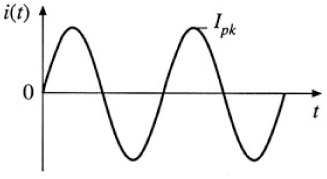
Sine wave, Fig. A.4:
| (A.4) | |
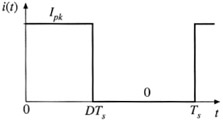
Pulsating waveform, Fig. A.5:
| (A.5) | |
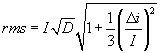
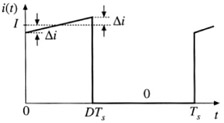
Pulsating waveform with linear ripple, Fig. A.6:
| (A.6) | |
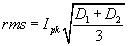
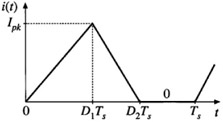
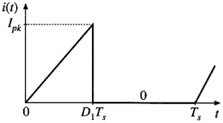
Triangular waveform, Fig. A.7:
| (A.7) | |
Triangular waveform, Fig. A.8:
| (A.8) | |
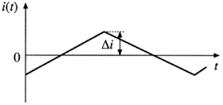
Triangular waveform, no dc component, Fig. A.9:
| (A.9) | |
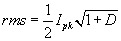
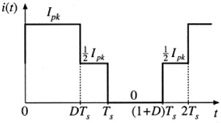
Center-tapped bridge winding waveform, Fig. A.10:
| (A.10) | |
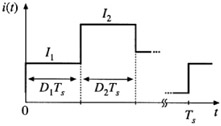
General stepped waveform, Fig. A.11:
| (A.11) | |
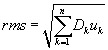
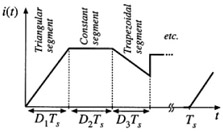
For a periodic waveform composed of n piecewise segments as in Fig. A.12, the rms value is
| (A.12) | |
where D k is the duty cycle of segment k, and u k is the contribution of segment k. The u ks depend...