Fundamentals of Power Electronics, Second Edition

Chapter 11: AC and DC Equivalent Circuit Modeling of the Discontinuous Conduction Mode

OVERVIEW

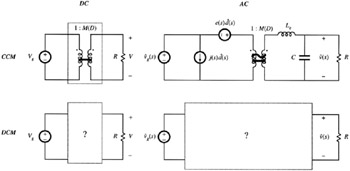
So far, we have derived equivalent circuit models for dc-dc pulse-width modulation (PWM) converters operating in the continuous conduction mode. As illustrated in Fig. 11.1, the basic dc conversion property is modeled by an effective dc transformer, having a turns ratio equal to the conversion ratio M( D). This model predicts that the converter has a voltage-source output characteristic, such that the output voltage is essentially independent of the load current or load resistance R. We have also seen how to refine this model, to predict losses and efficiency, converter dynamics, and small-signal ac transfer functions. We found that the transfer functions of the buck converter contain two low-frequency poles, owing to the converter filter inductor and capacitor. The control-to-output transfer functions of the boost and buck-boost converters additionally contain a right half-plane zero. Finally, we have seen how to utilize these results in the design of converter control systems.


Figure 11.1: The objective of this chapter is the derivation of large-signal dc and small-signal at equivalent circuit models for converters operating in the discontinuous conduction mode.

What are the basic dc and small-signal ac equivalent circuits of converters operating in the discontinuous conduction mode (DCM)? It was found in Chapter 5 that, in DCM, the output voltage becomes load-dependent: the conversion ratio M( D, K) is a function of the dimensionless parameter K = 2 L/ RT s, which in turn is a function of the load resistance R

UNLIMITED FREE
ACCESS
TO THE WORLD'S BEST IDEAS

SUBMIT
Already a GlobalSpec user? Log in.

This is embarrasing...

An error occurred while processing the form. Please try again in a few minutes.

Customize Your GlobalSpec Experience

Category: Switching Power Supplies
Finish!
Privacy Policy

This is embarrasing...

An error occurred while processing the form. Please try again in a few minutes.