Get Streaming!: Quick Steps to Delivering Audio and Video Online

We started this chapter by discussing important aspects of streaming media platforms and theplace of these platforms in your decision making. We advised you to perform a careful analysis ofyour audience and suggested several aspects to examine. We talked about some methods for optimizingyour audio and video source files in preparation for encoding. Finally, we spent time going overvarious encoding parameters and procedures for each of the major vendors.
By John Shay
The world is witnessing the emergence of third-generation (3G) mobile networks capable ofdelivering vast quantities of data and multimedia content to handheld consumer devices. Mobilenetworks are evolving from narrowband, circuit-switched networks, used primarily for voice andtext, to broadband, packet-switched networks capable of delivering a broad range of Internet-likemedia services. Compared to today s 2G (voice plus text messaging) and 2.5G (voice plus text andpicture messaging) networks, 3G mobile networks represent a profound leap in mobilecommunications.
A Paradigm Shift
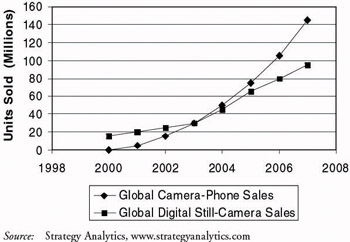
Multimedia-capable mobile networks signal a paradigm shift within the telecommunicationsindustry. The shift is most evident in the growing numbers of cell phones shipping with embeddedcameras. Camera-phones designed for 2.5G networks enable consumers to send messages containing bothpictures and text. Some observers predict camera-phones will outsell standard still cameras in 2004(See graph).

The ability to communicate in both words and pictures is a classic killer application.
3G Up and Running
Several 3G networks are running in Europe and Asia. The majority of 3G phones sold there comeequipped with multiple cameras supporting real-time, person-to-person video...