Global Airlines: Competition in a Transnational Industry, Second Edition

Chapter 4: Route Networks

4.1 Network Patterns

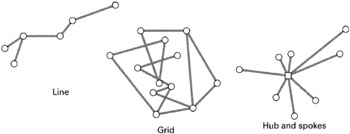
Most route patterns have an affinity to one or other of three basic types: line, grid or hub and spokes. These are illustrated in Figure 4.1.


Figure 4.1: Network patterns

In a line network the aircraft sets out from its base airport and makes a number of intermediate stops en route through to its ultimate destination. The intermediate stops are made either to refuel or to pick up traffic. Without stops some long haul services would not be operationally or economically viable. As aircraft range increases, or as the volume of long haul traffic grows, the need for intermediate stops becomes that much less. Although there are still plenty of airlines around the world that operate route systems like this, the emphasis has shifted very much away from line networks. For they have disadvantages on both the cost and revenue sides. Costs tend to be high, because station expenses are spread over just a few flights using each airport, maybe just one or two a week. This also means that local marketing is difficult and rather expensive in terms of average cost. At the same time cockpit cabin crews often have to have long stopovers or alternatively have to be ferried to their next flights; and in some cases long haul aircraft can be very inefficiently employed on relatively short sectors operated at low load factors at tail ends of the route. On the revenue side yields are often poor, because the low frequencies at which services...

UNLIMITED FREE
ACCESS
TO THE WORLD'S BEST IDEAS

SUBMIT
Already a GlobalSpec user? Log in.

This is embarrasing...

An error occurred while processing the form. Please try again in a few minutes.

Customize Your GlobalSpec Experience

Category: Aerospace Services
Finish!
Privacy Policy

This is embarrasing...

An error occurred while processing the form. Please try again in a few minutes.