Human Factors for Engineers

This volume introduces readers to the subject of human factors and provides practical and pragmatic advice to assist engineers in designing interactive systems that are safer, more secure and easier to use.
 TABLE OF CONTENTS
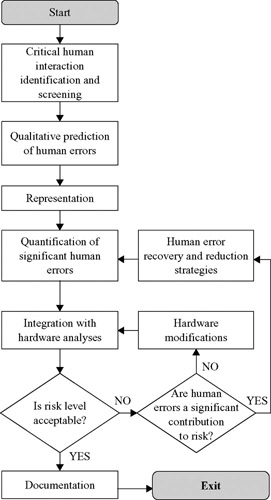
 The HIRAM framework is designed to be used either as a stand-alone methodology to provide an evaluation of the human sources of risk, or in conjunction with hardware-orientated analyses to provide an overall system safety assessment. The overall structure of the framework is set out in Figure 8.4. Figure 8.5 provides a flow diagram showing how this human-orientated analysis is integrated with the engineering risk analysis process described in Figure 8.1.
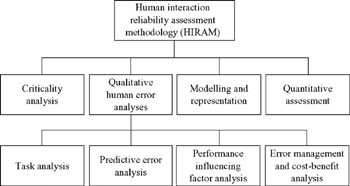
HIRAM comprises four stages.
The purpose of criticality analysis is to provide an indication of the main areas at risk from human-caused failures so that resources expended on human reliability assessment can be appropriately prioritised.
This stage involves the prediction of errors that could arise, using models of human error and the analysis of the Performance Influencing Factors, and the nature of the human interactions involved (e.g. actions, checking, communication). Only if human errors with significant consequences (loss of life or major damage) are identified will the subsequent stages of the process be performed. This stage, therefore, includes a consequence and error reduction analysis.
This stage involves representing the structure of the tasks in which errors with severe consequences could occur, in a manner that allows the probabilities of these consequences to be generated. The usual forms of representation...