Human Factors for Engineers

This volume introduces readers to the subject of human factors and provides practical and pragmatic advice to assist engineers in designing interactive systems that are safer, more secure and easier to use.
 TABLE OF CONTENTS
 If the results of the qualitative analysis are to be used as a starting-point for quantification, they need to be represented in an appropriate form. As discussed, the form of representation can be a fault tree, as shown in Figure 8.2, or an event tree (Figure 8.3). The event tree has traditionally been used to model simple tasks at the level of individual task steps, for example in the THERP (Technique for Human Error Rate Prediction) method for human reliability assessment [4] (see Section 8.7.3). It is most appropriate for sequences of task steps where few side effects are likely to occur as a result of errors, or when the likelihood of error at each step of the sequence is independent of previous steps.
If we consider the compressor filter case study described previously, the PHEA analysis shown in Table 8.3 indicates that the following outcomes (hazards) are possible for an unplanned compressor trip:
loss of production;
possible knock-on effects for downstream process;
compressor life reduced;
filter not changed;
oil not filtered will eventually damage compressor.
The overall fault tree model of the errors that could give rise to a compressor trip is shown in Figure 8.8. (For the purposes of illustration, technical causes of these failures are not included in the representation.)
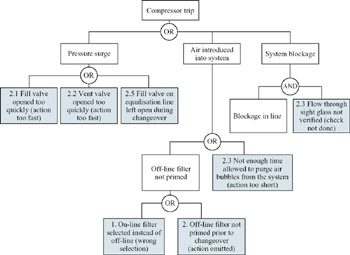
The overall probability of operator failure is obtained by multiplying probabilities at AND gates and combining values at OR gates as shown in Table...