Inorganic and Organometallic Polymers

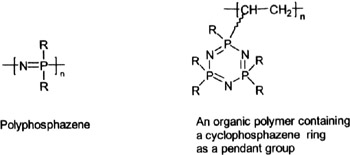
In the last chapter we have seen that organic polymers could be prepared by a number of ways taking advantage of the rich functional group chemistry of organic molecules. Unfortunately, it is not possible to extend these methodologies completely to inorganic polymers. As we will see in this and the subsequent chapters different types of inorganic polymers require different synthetic strategies. One approach that is common to the preparation of many inorganic polymers is ring-opening polymerization (ROP). This methodology relies on the choice of an appropriate inorganic ring that can be opened to a polymeric material. Obviously, in order for this strategy to succeed suitable inorganic rings have to be discovered and polymerized. In this Chapter we will deal with inorganic polymers known as polyphos-phazenes. These polymers contain alternate phosphorus and nitrogen atoms in their backbone (Fig. 3.1).
There are many other polymers that are related to the polyphosphazene family. Thus, there are polymers which are actually made up of an organic backbone but contain a cyclophosphazene ring as a pendant group appended in their side chain. Other polymers that are related to polyphos phazenes are those that contain a third hetero atom in the backbone. Examples of such polymers are shown in Fig. 3.2.
Polyphosphazenes have an intimate relationship with their cyclic counterparts. It is essential to obtain an understanding of the structure and reactivity of the cyclic derivatives in order to be able to extend...