Inorganic and Organometallic Polymers

In the previous chapter we have seen inorganic polymers that contained a [P=N] backbone. These polymers can be prepared by two principal methods.
Ring-opening polymerization of monomers such as N 3P 3Cl 6 or N 3P 3Cl 5R to the corresponding linear polymers followed by replacement of chlorines on the macromolecules by a variety of nucleophiles to afford polymers that contain P-O or P-N linked side-chains.
Catalytic or uncatalyzed polymerization of various kinds of N-silylphosphoranimines such as Me 3SiNPCl 3, Me 3SiNPRR ?X (X=OCH 2CF 3, OPh, Cl). This method is the most important route for the preparation of poly(alkyl/arylphosphazene)s.
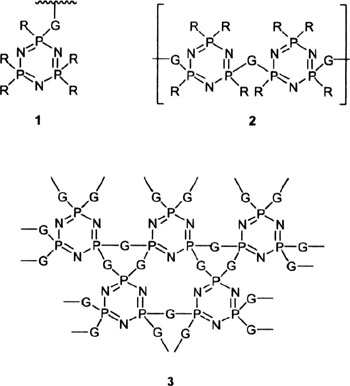
In this chapter we will examine polymers that contain inact cyclophosphazene units [ [1] [2] [3] [4]]. Examples of these kinds of polymers are shown in Fig. 4.1.
Polymer 1 (Fig. 4.1) is essentially an organic polymer containing a carbon backbone. We have seen in Chap. 2 that several types of organic polymers could be prepared by polymerizing vinyl monomers of the type CH 2=CHG by various types of initiators (see Eq. 4.1). The polymer properties could be varied significantly by change of the group G. Thus, for example, polystyrene prepared by polymerizing styrene (G=Ph) has completely different properties than poly(vinylchloride) prepared by polymerizing vinylchloride (G=Cl). In polymer 1, the G group is an intact cyclophosphazene unit. These polymers are potentially very...