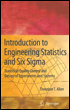
Introduction to Engineering Statistics and Six Sigma: Statistical Quality Control and Design of Experiments and Systems
Chapter 12: DOE Screening Using Fractional Factorials

12.1 Introduction

The methods presented in this chapter are primarily relevant when it is desired to determine simultaneously which of many possible changes in system inputs cause average outputs to change. " Factor screening" is the process of starting with a long list of possibly influential factors and ending with a usually smaller list of factors believed to affect the average response. More specifically, the methods described in this section permit the simultaneous screening of several ( m) factors using a number of runs, n, comparable to but greater than the number of factors ( n ~ m and n > m).

The methods described here are called "standard screening using fractional factorials" because they are based on the widely used experimental plans proposed by Fisher (1925) and in Plackett and Burman (1946) and Box et al. (1961 a, b). The term "prototype" refers to a combination of factor levels because each run often involves building a new or prototype system. The experimental plans are called fractional factorials because they are based on building only a fraction of the prototypes that would constitute all combinations of levels for all factors of interest (a full factorial). The analysis methods used were proposed in Lenth (1989) and Ye et al. (2001).

Compared with multiple applications of two-sample t-tests, one for each factor, the standard screening methods based on fractional factorials offer relatively desirable Type I and Type II errors. This assumes that...

UNLIMITED FREE
ACCESS
TO THE WORLD'S BEST IDEAS

SUBMIT
Already a GlobalSpec user? Log in.

This is embarrasing...

An error occurred while processing the form. Please try again in a few minutes.

Customize Your GlobalSpec Experience

Category: Darlington Transistors
Finish!
Privacy Policy

This is embarrasing...

An error occurred while processing the form. Please try again in a few minutes.