Introduction to Engineering Statistics and Six Sigma: Statistical Quality Control and Design of Experiments and Systems

Linear regression models are not the only curve-fitting methods in wide use. Also, these methods are not useful for analyzing data for categorical responses. In this chapter, so-called "kriging" models, "artificial neural nets" (ANNs), and logistic regression methods are briefly described. ANNs and logistic regression methods are relevant for categorical responses. Each of the modeling methods described here offers advantages in specific contexts. However, all of these alternatives have a practical disadvantage in that formal optimization must be used in their fitting process.
Section 2 discusses generic curve fitting and the role of optimization. Section 3 briefly describes kriging models, which are considered particularly relevant for analyzing deterministic computer experiments and in the context of global optimization methods. In Section 3, one type of neural net is presented. Section 4 defines logistic regression models including so-called "discrete choice" models. In Section 5, examples illustrate logit and probit discrete choice models.
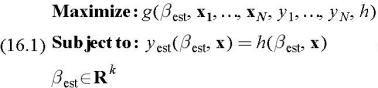
Many numerical approaches have been proposed for interpolating data points. A subset of these has been developed with the intention of mitigating the effects that random errors have on curve fitting, including linear regression, kriging models, and neural nets. All of these estimate their model parameters, ? est, based on their experimental inputs, x 1, , x N, and outputs, y 1, , y N, by solving an optimization program of the form
where predictions come from y est( ? est, x), which is...