Introduction to Engineering Statistics and Six Sigma: Statistical Quality Control and Design of Experiments and Systems

In this chapter, two additional case studies illustrate design of experiments (DOE) and regression being applied in real world manufacturing. The first study involved the application of screening methods for identifying the cause of a major quality problem and resolving that problem. The second derives from Allen et al. (2000) and relates to the application of a type of response surface method. In this second study, the design of an automotive part was tuned to greatly improve its mechanical performance characteristics.
Note that Chapter 13 contains a student project description illustrating standard response surface methods and what might realistically be achieved in the course of a university project. Also, Chapter 14 reviews an application of sequential response surface methods to improve the robustness and profitability of a manufacturing process.
In this section, the so-called "Rubber Machine" case study is presented. This study is similar to the printed circuit board (PCB) study from an earlier chapter and from Brady and Allen (2002) described in Chapter 12. In this rubber machine study, a machine was essentially broken for several months, and the techniques permitted resolution of the related quality problems, greatly increasing return on investment. The study also illustrates the dangers and inefficiencies of one-factor-at-a-time (OFAT) approaches to experimentation described in Chapter 12.
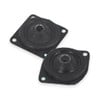
A Midwestern factory makes a small component used in air conditioning compressors for in-home applications, shown in Figure 17.1. The company has established itself as the low cost...