Managing Risk and Reliability of Process Plants
When you have studied this chapter, you will have an understanding of some of the engineering and managerial options for reducing risks of process incidents of various types.
This chapter addresses risk management step 10, "Reduce the Risk," in Figure 1-4.
The factors which determine the safety of a hazardous plant, machine, or operation, or a transport operation, are:
inherent hazard,
adequacy of containment and control of the hazardous facility or operation (both hardware and software),
adequacy of the protective systems (both hardware and software), and
damage limitation.
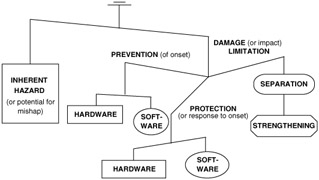
Conceptually, the inherent hazard needs to be balanced by the total safety package. This is displayed in the Risk Balance [1] of Figure 8-1 (Tweeddale, 1985).
In principle, the preferred approach to risk reduction is to work from the top of the list, downward, that is, from the left-hand side of the diagram toward the right-hand side.
First, the inherent hazard should be eliminated or reduced as far as reasonably practicable. This can be done most easily at the outset of a proposed design, but it is often possible to make significant improvements to an existing plant.
The dimensions of the inherent hazard are:
the quantity of the hazardous materials present (the more material present, the greater the potential consequences of a mishap);
the physical and chemical properties of the materials (some materials are more reactive or toxic...