Materials Science in Microelectronics: The Relationships Between Thin Film Processing and Structure, Volume 1, Second Edition
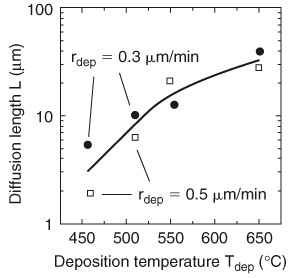
DLTS, photoluminescence and temperature dependent quantum efficiency measurementsA1 have revealed that the point defect densities in Si films formed by ion-assisted homoepitaxial deposition onto Si(100) decrease with increasing deposition temperature. At 550 C this density is 10 13/cm 3. Further, decrease in this density is revealed by increase in the minority carrier diffusion length, as shown in Figure 4.A1 Even at a deposition temperature of 650 C the minority carrier lifetime indicates that it has notyet reached its maximum value with increase in the deposition temperature. In the range of temperature shown in this figure the extended defect density remains constant with deposition temperature. Thus, the minority carrier lifetime is a function here only of the point defect density. These point defects are a consequence of the production of Frenkel defects by the hyperthermal Si ions used in the ion-assisted deposition mode of forming these films. Such point defects are not present to the same densities in normal high temperature MBE deposition on Si(100). Indeed, in MBE deposition on Si(100) in the absence of a hyperthermal beam it is known that surface vacancies in the adatom layers anneal out before being buried at and above about 600 C and that no interstitials are formed.
Figure 4.A2 shows the point defect density calculated using the data...