Materials Science in Microelectronics: The Relationships Between Thin Film Processing and Structure, Volume 1, Second Edition

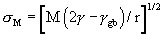
In the original edition of this book attention was focussed on the fact that in the zone a range of temperature, where deposited atoms stick where they hit, the existence of porosity in the films must lead to a modification of prior theories for the origin of the intrinsic tensile stress. This porosity exists, as noted in Chapter II, between the columns or columnar grains formed in the deposition process. The origin of the tensile stress in the Hoffman1 and subsequent models is the decrease in free energy that occurs when the energy associated with the tensile stress and grain boundary energy is less than the surface energy removed on formation of the grain boundaries. Since porosity is observed in films in the zone a regime it is apparent that there still exists internal surface area and energy in the film. To the extent that voids exist (that there is space between columns not filled by cohering atoms), the magnitude of the average tensile stress in the films must be less than that deduced from the Hoffman analysis. If all the voids in the intercolumnar space were to disappear either to form grain boundaries between crystal grains or to produce a continuous bonded network between amorphous columns then the intrinsic tensile stress would not exceed the value given by
where M is the biaxial elastic modulus, ? is the specific surface energy, ? gb