Microsoft Exchange 2000 Infrastructure Design: Co-existence, Migration, and Connectivity
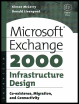
A book that bridges the gap between running the Exchange 2000 setup program and having a working system.
 TABLE OF CONTENTS
 Exchange 2000 is radically different from Exchange 5.5 or any of its predecessors. Architecturally, it's a world away from the self-contained messaging system that is Exchange 5.5. Those components that are built into Exchange 5.5, such as the Directory Service, the SMTP service, and so on, are now separated out from Exchange itself and, in most cases, integrated into the underlying operating system. For Exchange 2000, that operating system is Windows 2000.
Exchange 2000 positively requires Windows 2000 in order to function. The Exchange 2000 executables don't run under any earlier operating system versions, and in order to have an Exchange 2000 mailbox, you must have a Windows 2000 account. Why is there such a dependency? Well, there are a variety of reasons, but one of the most important reasons is the Active Directory.
Exchange 5.5 has a reliable and distributable directory service built in. There is no directory service built into Exchange: Exchange 2000 relies completely on the Active Directory to store information about mailboxes, custom recipients, and distribution lists, although these Exchange 5.5 primitives are represented differently in Exchange 2000. Furthermore, all of the configuration information about Exchange servers that are held in the Configuration container of the Exchange 5.5 Directory Service, are now held in the Configuration Naming Context of the Active Directory with Exchange 2000. So what does all of this remodeling mean? First, it means that Exchange 2000 has a huge dependency on the Active Directory. Accordingly, you must get the design of...