Microsoft Exchange 2000 Infrastructure Design: Co-existence, Migration, and Connectivity

A book that bridges the gap between running the Exchange 2000 setup program and having a working system.
 TABLE OF CONTENTS
 This chapter discusses the basic concepts of a message transfer service and introduces Simple Mail Transfer Protocol (SMTP). In addition, we'll cover the SMTP service offered in Windows 2000 and discuss some of the characteristics available in Windows 2000's SMTP service that differ from those required or needed in the Exchange 2000 transport.
Most readers realize the importance of a message transfer service within a product as it pertains to electronic messaging. In its simplest form, a transfer service allows multiple systems to easily exchange information, typically e-mail. Add to that service a solid routing model and the transfer service can now efficiently transfer information through a network. The architecture used to build a transfer service can also enhance a messaging service by providing the following:
Basic communications
Horizontal scalability
Separation of services
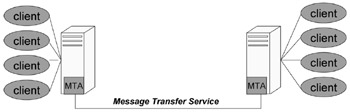
When a messaging system must span more than one physical server, a transfer service enables communication between those servers. Typically, a store-and-forward transfer service is implemented to ensure message delivery. Information communicated is normally in the form of messages, but the content could be messages, directory information, or application data. Figure 8.1 depicts servers communicating via a transfer service.
It may come as a surprise to many that in the early days of PC-based messaging, Message Transfer Services were not built into the messaging systems. For example, cc:Mail and MS-Mail were designed for LAN use and did not include a store-and-forward transfer service. Instead,...