Microsoft Exchange 2000 Infrastructure Design: Co-existence, Migration, and Connectivity
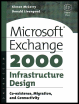
A book that bridges the gap between running the Exchange 2000 setup program and having a working system.
 TABLE OF CONTENTS
 I often describe the Active Directory Connector as the light-saber of Exchange 5.5 migration, because it's extremely powerful and seems straightforward to implement; yet much like its fictional counterpart, the ADC is actually quite a sophisticated tool that requires a good deal of mastery and careful use if it is to ultimately yield success.
As you migrate from Exchange 5.5 to Exchange 2000, it's unlikely that you'll be able migrate all Exchange 5.5 users in one single action. What's more likely, especially when you have thousands of users in your environment and multiple Windows NT4 domains, is a long period of coexistence during which there will be a mixture of both Exchange 5.5 users and Exchange 2000 users. Correct deployment of the ADC and appropriate CA topologies are key to facilitating this coexistence.
Much of the information about the ADC that I've described thus far relates to discrete aspects of ADC functionality. In this chapter, I hope to tie those functionality aspects together and give a complete picture of ADC use in a coexisting Exchange 5.5 and Exchange 2000 environment.
Let's take a step back quickly and review some coexistence fundamentals. A Windows 2000 domain is said to be in native mode if it contains only Windows 2000 Domain Controllers. So long as you meet this requirement, you can have any mix of Windows NT4 and Windows 2000 Member Servers in the domain that you like. A Windows 2000...