Plastics for Corrosion Inhibition

Inhibited films of different structures, properties and designation are manufactured by various methods using a wide range of film-forming polymers and CI (see Sect. 1.3 and 2.1).
Film materials incorporate a high-molecular base and a low-molecular CI coexisting in different aggregate states and so having essentially different physical-chemical and processing characteristics. Inhibited films should fulfill the following three main functions: support the mechanical load, form a diffusive barrier to the hostile media and be a CI carrier. Two contradictory problems are to be solved during their production, that is, to reliably combine CI with the polymer matrix so as to guarantee film operation as an integral whole, and to make polymer links with the CI weak enough to allow its free liberation from the film. Solution of the problem lies within the thermodynamic and process compatibility spheres of the ingredients of the inhibited polymer materials (see Sect. 1.4)
The production technique for inhibited films presumes joint processing of their components during which the polymer and CI are brought into contact.
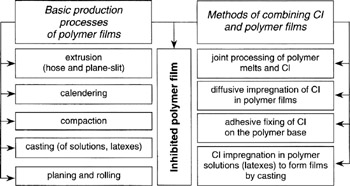
On one hand, inhibited films employ traditional process methods and equipment used for molding film materials. On the other hand, special operations and auxiliaries are needed to modify the polymer base with CI (Fig. 2.4). A number of methods of combining CI with the polymer matrix are unique and patented.
The production technique for inhibited films responds to the requirements imposed in terms of...