Practical Machinery Vibration Analysis and Predictive Maintenance

One of the key elements of any oil analysis program is to obtain a sample that is not contaminated by external contaminants, garbage in is garbage out . It must be appreciated that an oil analysis is searching for microscopic wear particles, and external contaminants can influence the results when being observed under a microscope.
Thus, the method of sampling, apparatus, accessories, procedure and sampling frequency all determine the informative content of the sample and this subsequently determines how beneficial results will be. The key factors to be addressed while designing a sampling program are:
Best location in many cases it is machine specific
Best tools vacuum pumps, sampling bottles, valves, traps, etc.
Minimising contamination.
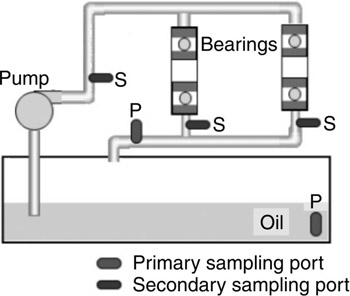
Diagnosis of component health using oil analysis is greatly enhanced by providing sampling ports at proper locations. Ports should be in locations so that oil from individual components can be collected. This provides an analytical edge for detecting incipient failures and arriving at the root cause of failures. Sample ports are generally divided into two categories, primary and secondary (Figure 7.1).
Routine oil samples are collected from this port. The aim is detection of wear particles, oil contamination and to test the physical and chemical properties of the oil. As mentioned before, these often depend on the type of machine and can also vary from system to system. However, the primary ports are typically located...