Practical Machinery Vibration Analysis and Predictive Maintenance

Once contaminants enter the circulation system they tend to cause wear and failure of components. However, if these contaminants are trapped and subsequently analyzed it is possible to trace their origins and the extents of damage that can be expected. To analyze the contaminants, many methods like spectrometric analysis, infrared analysis, particle counting, wear particle analysis and others are used.
Each technique has niche applications and its own limitations. These limitations can be compensated for through the use of other techniques. This makes oil analysis a powerful predictive maintenance tool.
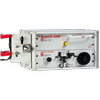
Spectrometric analysis is one of the main techniques used in particle analysis. It is primarily used for trending the accumulation of small wear metals and elemental constituents of additives and for identifying the possible introduction of contaminants. The results of a spectrometric analysis are typically reported in ppm (parts per million). Spectrometric analysis monitors the smaller particles present in the oil. Large wear metal particles will not be detected.
In the spectrometer, oil is excited electrically to the point where it will emit light. Each element present in the burning oil emits a light of characteristic color and frequency. Spectrometers translate the intensity of the colors into a computerized readout. A typical report from this test would list nine major wear metals for industrial gear oil and hydraulic oils. A test for twelve elements is conducted for automotive oils. The computer compares the present amount of wear metals with a fresh oil sample...