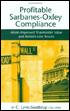
Profitable Sarbanes-Oxley Compliance: Attain Improved Shareholder Value and Bottom-Line Results
Prior to the establishment of the PCAOB, the AICPA was responsible for setting technical accounting and auditing standards for the accounting profession. It also provided the guidance and direction for examinations leading to licensing for the profession. However, it is important to realize that licensing is regulated by each state, so some variation can creep into the process. Accounting and auditing standards were a critical responsibility of the AICPA for all companies prior to the PCAOB and now only provide guidance relative to private companies. Accounting standards are set by the FASB, which is under the direction of the PCAOB. Peer reviews were also a function of the AICPA.
We can clearly begin to see where a shift in relevance has occurred with the emergence of Sarbanes-Oxley. Now the waters are murky as the AICPA sorts out its new vision and mission. The organization is focused on supporting its members and the public interest. While its role is no longer that of a primary standards setter, it is providing guidance and direction in supporting its members in areas of ethics, education, and high-quality services to their clients. The organization has a total membership that exceeds 350,000 nationally and internationally, so when we look at the reach of the organization, there is no question that it is broad. Its membership uses the wide range of technical and other materials offered as work aids and support in providing a broad range of services. The materials and support services...