Surface Production Operations: Design of Oil Handling Systems and Facilities, Volume One, Third Edition
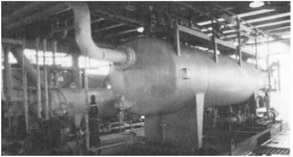
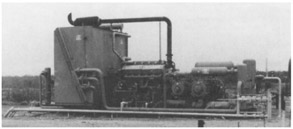
The job of a production facility is to separate the well stream into three components, typically called "phases" (oil, gas, and water), and process these phases into some marketable product(s) or dispose of them in an environmentally acceptable manner. In mechanical devices called "separators," gas is flashed from the liquids and "free water" is separated from the oil. These steps remove enough light hydrocarbons to produce a stable crude oil with the volatility (vapor pressure) to meet sales criteria. Figures 1-1 and 1-2 show typical separators used to separate gas from liquid or water from oil. Separators can be either horizontal or vertical in configuration. The gas that is separated must be compressed and treated for sales. Compression is typically done by engine-driven reciprocating compressors (see Figure 1-3). In large facilities or in booster service, turbine-driven centrifugal compressors, such as that shown in Figure 1-4, are used. Large integral reciprocating compressors are also used (see Figure 1-5).