Surface Production Operations: Design of Oil Handling Systems and Facilities, Volume One, Third Edition

Configurations

Skim vessels can be either vertical or horizontal in configuration.

Vertical

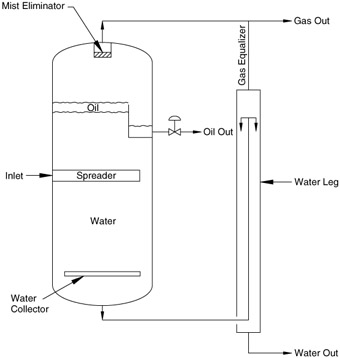
In vertical skimmers the oil droplets must rise upward countercurrent to the downward flow of the water. Some vertical skimmers have inlet spreaders and outlet collectors to help even the distribution of the flow, as shown in Figure 9-7. The oil, water, and any flash gases are introduced below the oil-water interface. Small amounts of gas liberated from the water help to "float" the oil droplets. In the quiet zone between the spreader and the water collector, some coalescence can occur, and the buoyancy of the oil droplets causes them to rise counter to the water flow. Oil will be collected and skimmed off the surface.


Figure 9-7: Schematic of a vertical skimmer vessel.

The thickness of the oil pad depends on the relative heights of the oil weir and the water leg and on the difference in specific gravity of the two liquids. Often, an interface level controller is used in place of the water leg.

Horizontal

In horizontal skimmers the oil droplets rise perpendicular to the flow of the water, as shown in Figure 9-8. The inlet enters in the water section so that the flashed gases may act as a dissolved gas flotation cell. The water flows horizontally for most of the length of the vessel. Baffles could be installed to straighten the flow. Oil droplets coalesce in this section of the vessel and rise to the oil-water surface, where they are captured and eventually...

UNLIMITED FREE
ACCESS
TO THE WORLD'S BEST IDEAS

SUBMIT
Already a GlobalSpec user? Log in.

This is embarrasing...

An error occurred while processing the form. Please try again in a few minutes.

Customize Your GlobalSpec Experience

Category: Oil Skimmers
Finish!
Privacy Policy

This is embarrasing...

An error occurred while processing the form. Please try again in a few minutes.