Surface Production Operations: Design of Oil Handling Systems and Facilities, Volume One, Third Edition

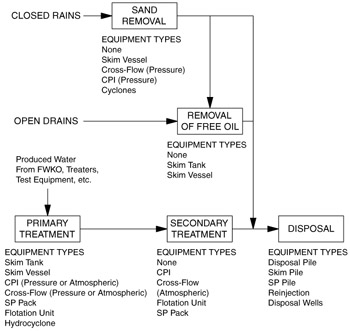
Table 9-2 lists the various methods employed in produced water treating systems and the types of equipment that employ each method. Figure 9-4 shows a typical produced water treating system configuration. Produced water will always have some form of primary treating prior to disposal. This system could take the form of a skim tank, skim vessel, CPI, cross-flow separator, or gas flotation unit. Other than the gas flotation unit, all of these devices employ gravity separation techniques. Depending upon the severity of the treating problem, secondary treatment may be required. Secondary treatment could utilize a CPI, a cross-flow separator, or a gas flotation unit. Liquid-liquid hydrocyclones or centrifuges are often used either in a single stage or with an upstream or downstream skim vessel or flotation unit.
| Method | Equipment Type | Approximate Minimurr Drop Size Removal Capacities (Microns) |
|---|---|---|
| Gravity separation | Skimmer tanks and vessels | |
| API separators | 100 150 | |
| Disposal piles | ||
| Skim piles | ||
| Plate coalescence | Parallel plate interceptors | |
| Corrugated plate interceptors | 30 50 | |
| Cross-flow separators | ||
| Mixed-flow separators | ||
| Enhanced coalescence | Precipitators | |
| Filters/coalesces | 10 15 | |
| Free-flow turbulent coalesces | ||
| Gas flotation | Dissolved gas | |
| Hydraulic dispersed gas | 10 20 | |
| Mechanical dispersed gas | ||
| Enhanced gravity separation | Hydrocyclones | 15 30 |
| Centrifuges | ||
| Filtration | Multimedia membrane | 1+ |
Offshore, produced water can be piped directly overboard after treating, or it can be routed through a disposal pile or a skim pile. Water from the deck drains must be treated for...