System Requirements Analysis

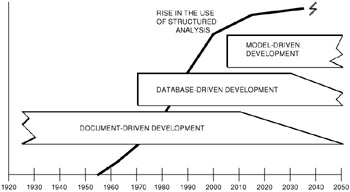
Throughout the previous chapters, the notion of computer applications kept arising; but an attempt has been made to keep the computer out of the earlier material as much as possible to focus on the human process, because it is people using their brains who develop requirements. Also, because everyone who uses this book will not be so fortunate as to have easy access to a computerized requirements analysis and capture tool, the author believes that those without computers should be able to get some benefit from the book. If, by the way, you are in this condition, without a computer tool, you should recognize that you are probably falling behind your competition. Figure 7.1-1 illustrates an evolution going on in system development that is accelerating over time. Dates offered are notional and not based on serious historical research or thoughtful contemplation of the future.
Throughout the 20th century, specifications were generally published using typewriters or word processors and reproduction or typesetting and printing. The content of these specifications was often determined through ad hoc approaches using specification standards templates. In the 1960s, people in large customer and development organizations began experimenting with the use of computer databases to capture the requirements. Commonly, the database was used as the source for printing paper specifications as well as making it...