Additive Migration from Plastics into Foods: A Guide for Analytical Chemists

In earlier work on the theory governing the rate of migration of extractable additives and other components from plastics into liquids, Garlanda and Masoero [1, 2] considered the extraction from the point of view of the Fickian Laws of diffusion and they mathematically examined the way in which this migration varies with respect to the principal parameters of the system such as time and temperature, polymer thickness, choice of extractant liquid and so on.
Garlanda and Masoero [1, 2] start off their treatment by considering the simple case of the migration of additives from a flat sheet of plastic. For a plastic sheet which contains a substance capable of diffusing along the x axis, perpendicular to the surface of the sheet:
Fick s first law is:
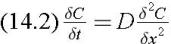
Fick s second law is:
Where:
C is the concentration of migrant in plastic at time t and position x,
F is the quantity of diffusing substance moved in units of time and area,
t is the time, and,
D is the coefficient of diffusion, which is a constant since the initial concentration of additive within the sheet (C o) varies in the range of concentrations considered.
Assuming that at the start of the migration test, the concentrations of additive within and at the surface of the sheet are C o and C, respectively, and that the sheet is immersed in a large volume of extraction liquid, then for short time intervals or great polymer sheet...