Adhesion to Fluoropolymers
Of interest to those who already use fluoropolymers and those who are considering using them, this book is mainly concerned with the wide variety of methods available to pretreat fluoropolymers.
A knowledge of the surface chemistry of substrates is important in our understanding of adhesion. There are many techniques which provide information on the surface chemistry of plastics. Of particular importance is XPS, also known as electron spectroscopy for chemical analysis (ESCA). This technique is outlined in Section 3.2. Static secondary ion mass spectrometry (SSIMS) and reflection infrared analysis are also widely used. Topography, which can have an important effect on adhesion, may be examined using electron microscopy or atomic force microscopy.
In this technique a solid, e.g., a plastic film, is bombarded with X-rays of known energy under high vacuum. Photoelectrons from different core levels are ejected. Photoelectrons from the first few atomic layers have a characteristic kinetic energy depending on the elements present in the surface regions. The binding energy of a photoelectron from a particular core level is given by the equation:
| (2) | 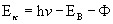 |
| where: | E ? is the kinetic energy of the photoelectron |
| h v is the X-ray energy | |
| E B is the binding energy of the photoelectron | |
| ? is the constant for a given instrument |
A schematic diagram of the equipment used is shown in Figure 1. By scanning different energies, a spectrum is obtained. The elements present in the first few atomic layers can be readily identified from their characteristic binding energies. The percentage concentration of each element can be calculated from the following equation:
| (3) | 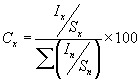 |
| where: | C x =... |

 TABLE OF CONTENTS