Airy Functions And Applications To Physics

Chapter 2: Definitions and Properties

This chapter is devoted to general definitions and properties of Airy functions as they can be, at least partially, found in the chapter concerning these functions in the " Handbook of Mathematical Functions" by Abramowitz & Stegun (1965).

2.1 The Homogeneous Airy Functions

2.1.1 The Airy's equation

We consider the following homogeneous second order differential equation called the Airy's equation

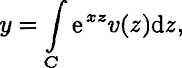
This differential equation may be solved by the method of Laplace, i.e. in seeking a solution as an integral

this is equivalent to solve the first order differential equation

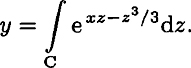
We thus obtain the solution to the equation (2.1), except a normalisation constant,

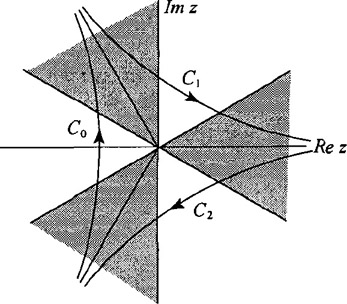
The integration path C is chosen such that the function v( z) must vanish at the boundaries. This is the reason why the extremities of the path must go into the regions of the complex plane z, where the real part of z 3 is positive (shading regions of the complex plane).

From symmetry considerations, it is useful to work with the paths C 0, C 1 and C 2. Clearly the integration paths C 1 and C 2 lead to solutions that tend to infinity when x goes to infinity. When we consider the path C 0 and the associated solution, we can deform this curve until it joins the imaginary axis. Now we define the Airy function A i by

If 1, j, j 2 are the cubic roots of unity...

UNLIMITED FREE
ACCESS
TO THE WORLD'S BEST IDEAS

SUBMIT
Already a GlobalSpec user? Log in.

This is embarrasing...

An error occurred while processing the form. Please try again in a few minutes.

Customize Your GlobalSpec Experience

Category: Wavelength Meters
Finish!
Privacy Policy

This is embarrasing...

An error occurred while processing the form. Please try again in a few minutes.