8.1.1 Particle in a uniform field
Let us consider a free, q charged particle, moving on the  axis plunged into a uniform electric field
  . This particle is submitted to the force
  and its potential energy is U = ? Fx. So the Schr dinger equations is checked by the wave function of the particle
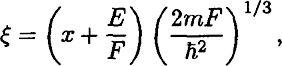
where E is the total energy of the particle. Let us perform the change of variable
where ? is a one dimensional variable. Then, the Schr dinger equation is reduced to the Airy equation (2.1)
The solution of this equation is
where Ai and Bi are the homogeneous Airy functions. But Bi(x) goes to infinity for x > 0. This solution is not relevant, so N ? = 0, then the solution of the equation (8.2) is reduced to
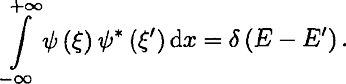
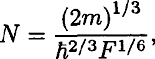
The constant N is determined by the energy normalisation condition for the wave functions of the continuum spectrum [Landau & Lifchitz (1966)]
Then we obtain
and the exact solution of Eq. (8.1) is
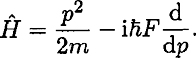
Of course, we can obtain this result by seeking the wave function ?( p) in the momentum representation [Landau & Lifchitz (1966)]. With the previous notations, the Hamiltonian operator in the momentum representation is
Then, the Schr dinger equation for the wave function ?( p) is
Solving this equation, we get
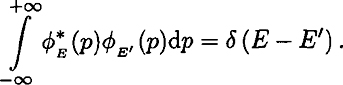
which is energy normalised by the condition
The wave function in the position space,...


 TABLE OF CONTENTS