Airy Functions And Applications To Physics

Chapter 5: The Uniform Approximation

5.1 Oscillating Integrals

5.1.1 The method of stationary phase

In this paragraph, we are going to present the stationary phase method, which was studied during the early XX th by Stokes, Kelvin and Brillouin. Erd lyi (1956) and later Copson (1967) detailed this method. A more recent review paper by Knoll & Schaeffer (1977), can also be quoted.

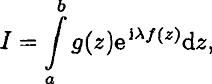
Let us consider an integral of the form

where ? is an arbitrary large parameter.

If the function occurring in this integral is analytic, in a given domain of the complex plane, the integration contour can be deformed. The aim is to obtain an approximation of I in the limit ? ? ?, it is then advantageous to keep the contour in regions where the integrand is as small as possible. If a topography of the complex plane with e i ? f( z) as an altitude is introduced, it is then easier to speak, by analogy, of valley and top. Thus the most favourable contours will be those that remain as far as possible in the valleys, except for the transitions from one valley to another, i.e. at points like z i such that: f ?( z i) = 0. This is the reason why this method is also called the steepest descent method. The points z i are called the stationary points, they are the points where the integrand is maximum giving the most important contribution to the value...

UNLIMITED FREE
ACCESS
TO THE WORLD'S BEST IDEAS

SUBMIT
Already a GlobalSpec user? Log in.

This is embarrasing...

An error occurred while processing the form. Please try again in a few minutes.

Customize Your GlobalSpec Experience

Category: Solid Phase Extraction Cartridges and Disks
Finish!
Privacy Policy

This is embarrasing...

An error occurred while processing the form. Please try again in a few minutes.