5.1.1 Heat Equation
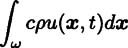
Imagine that a domain ? ? R 3 is occupied with the heat conductor, and let u = u( x, t) be the temperature at the position x = t( x 1, x 2, x 3) ? ? and the time t > 0. If ?, c, and ? denote the ratio of specific heat, the density, and a subdomain of ? with smooth boundary ??, respectively, then
denotes the heat quantity put in ? On the other hand,
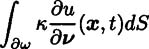
indicates the heat quantity radiated inside ? through ??, where ? and dS denote the outer unit normal vector and the area element of ??, respectively. Therefore, it holds that
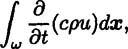
If u( x, t) is smooth, the left-hand side of (5.1) is equal to
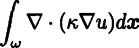
while the right-hand side is
from the divergence theorem of Gauss. Because ? is arbitrary, this implies that
which is referred to as the heat equation. Usually, side conditions are provided to determine u( x, t), so that the initial condition is given...

 TABLE OF CONTENTS