Applied Analysis: Mathematical Methods In Natural Science

Chapter 6: Nonlinear PDE Theory

Although nonlinear partial differential equations have vast varieties, they share several common features and techniques. This chapter is devoted to the non-negative solution to semilinear heat equation u t = ? u + u p on the whole space R n. If the nonlinearity is strong as , then small initial data admits the solution globally in time. On the contrary, if it is weak as , then any non-trivial initial data make the solution to continue to t = + ? impossible. This phenomenon was noticed by H. Fujita in 1966, and is called Fujita's critical exponent.

6.1 Method of Perturbation

6.1.1 Duhamel's Principle

In 5.2.4, we have derived from

that

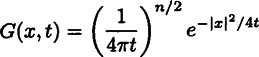
where

denotes the Gaussian kernel. Actually, if u 0 ? L p( R n) with p ? [1, ?) then u( x, t) defined by (6.2) satisfies (6.1) and

We note that the right-hand side of (6.2) converges for more rough data, say

where C > 0 and ? ? (0, 2) are constants.

Duhamel's principle asserts that the solution

is given by

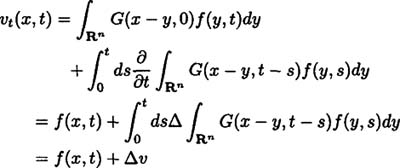
This is obtained from the law that

In fact, putting

we have formally that

because of G( x, 0) = ?( x). The above argument is formal because the behavior as t ? 0 of G( x, t) is not obvious.

Exercise 6.1

Give a sufficient condition to u 0

UNLIMITED FREE
ACCESS
TO THE WORLD'S BEST IDEAS

SUBMIT
Already a GlobalSpec user? Log in.

This is embarrasing...

An error occurred while processing the form. Please try again in a few minutes.

Customize Your GlobalSpec Experience

Category: Thermocouple Elements
Finish!
Privacy Policy

This is embarrasing...

An error occurred while processing the form. Please try again in a few minutes.