Breakdown Phenomena in Semiconductors and Semiconductor Devices
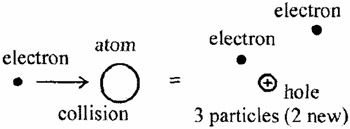
The basis of all ionization, breakdown and avalanche effects, without exception, is the elementary act of ionization (Fig. 1.1).
A free carrier (electron or hole) "impact" on the atom of a semiconductor. If the energy of the carrier is large enough, this carrier will "knock out" the electron from the valence shell of the atom. As a result, two new free carriers, an electron and a hole, appear. In other words, if an initial carrier has enough energy, it can initiate the transition of an electron from a valence band to a conduction band. The minimal energy necessary to carry out the act of impact ionization is called the threshold energy E th. It is clear from the law of energy conservation that the threshold energy cannot be less than the energy gap of the semiconductor E g.
The laws of energy conservation and momentum conservation must nevertheless be satisfied simultaneously in the process of an elementary act of ionization. As a result, E th > E g. In the case of the simplest dispersion law for electrons and holes (Fig. 1.2), the relation between the energy of the particles E and their wave vector k is defined as
(an approximation for the isotropic effective mass m