Breakdown Phenomena in Semiconductors and Semiconductor Devices
Chapter 5: Dynamic Breakdown

5.1 Introduction

As mentioned in Section 2.1, the breakdown scenario depends critically on the ramp dV 0/ dt. Over a very wide range of magnitudes of dV 0/ dt the conventional (static or quasi-static) breakdown scenario discussed in Chapter 3 is followed, but if dV 0/ dt ramp becomes extremely large the picture changes dramatically.

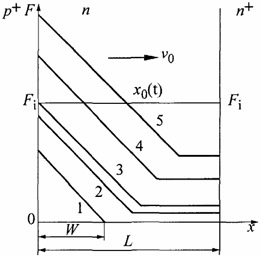
To establish the criteria for static and dynamic breakdown, let us consider the situation in which a relatively small voltage V 0 << V i (where V i is the static breakdown voltage) is applied to a reverse-biased p - n junction (Figure 5.1, curve 1).


Figure 5.1: Qualitative field distribution across the base of a reverse-biased p + - n junction when a large reverse current I 0 is flowing through the diode. At every point in the space-charge region (SCR) the field increases in time according to the law dF/ dt = I 0/ ? ? 0 S = j 0/ ? ? 0. Point x 0 moves to the right with a velocity , where j N = eN dv s.

The left-hand part of the base region of W length is completely depleted (space-charge (SCR) or depleted region). The electric field in this region decreases linearly with x according to the Poisson equation dF/ dx = eN d/ ? ? 0.

UNLIMITED FREE
ACCESS
TO THE WORLD'S BEST IDEAS

SUBMIT
Already a GlobalSpec user? Log in.

This is embarrasing...

An error occurred while processing the form. Please try again in a few minutes.

Customize Your GlobalSpec Experience

Category: Diodes
Finish!
Privacy Policy

This is embarrasing...

An error occurred while processing the form. Please try again in a few minutes.