Breakdown Phenomena in Semiconductors and Semiconductor Devices

Chapter 2: Avalanche Multiplication

2.1 Fundamentals of Avalanche Multiplication

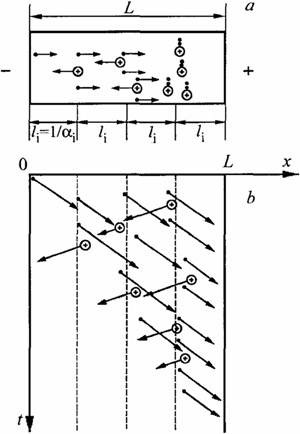
Let us consider the following simple situation. An electron is injected into a sample of length L with a homogeneous field F (Fig. 2.1). Let us suppose that at this given field F the electron ionization rate ? i is much larger than the hole ionization rate ( ? i >> ? i), so that ? iL, >> 1 but / ? iL << 1 This means that the electron performs numerous elementary acts of impact ionization as it passes through the sample. On the other hand, the probability of a hole making even one act of impact ionization is practically zero.


Figure 2.1: An electron is injected into a sample from the left. In travelling a distance l i = 1/ ? i (on average) it will create a new electron and a hole. The hole will move to the left (without ionization), while emergent electrons will move to the right and create further electron-hole pairs, and so on.

In this simplest case we have

(2.1)

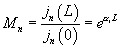
and a multiplication factor M n for electrons injected at the cathode M n = i n( L) /j n(0) is equal to

(2.2)

For a non-homogeneous field distribution across the sample:

(2.3)

It is worth noting that in this simplest case ( ? iL << 1) the multiplication factor M is always a finite value. It may be...

UNLIMITED FREE
ACCESS
TO THE WORLD'S BEST IDEAS

SUBMIT
Already a GlobalSpec user? Log in.

This is embarrasing...

An error occurred while processing the form. Please try again in a few minutes.

Customize Your GlobalSpec Experience

Category: Radiation Detectors
Finish!
Privacy Policy

This is embarrasing...

An error occurred while processing the form. Please try again in a few minutes.