Chaos, Bifurcations And Fractals Around Us: A Brief Introduction, Series A, Vol. 47

4.2. The Single Potential Well Motion

4.2. The Single Potential Well Motion

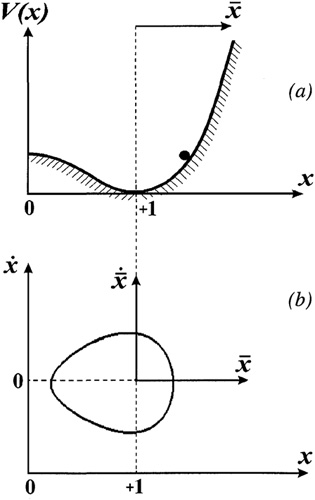
Let us start with Figure 4.3 where only the right half-plane of the potential diagram V=V(x), i.e. the neighborhood of the right minimum of potential energy, is displayed. We also introduce an additional coordinate x= x ?1, which defines horizontal displacement from that minimum. Equation of motion, with respect to the new coordinate x , takes the form

(4.4)

where the natural frequency of oscillations of the ball around the equilibrium position x=0 equals 1.


Fig. 4.3: The right potential well; (a) potential energy diagram; (b) phase portrait of the T-periodic single-well oscillation.

Figure 4.3(a) shows clearly that the single potential well is asymmetric with respect to x=0. Therefore, we may expect that the motion of the ball within the well will be asymmetric too. Indeed, the phase portrait of T-periodic single-well motion appears to be asymmetric (Figure 4.3(b)).

Next, in Figure 4.4(a) we plot a schematic diagram of the maximal displacement x max versus the driving frequency ?, in the vicinity of the principal resonance, i.e. close to ?=1. Likewise in the case of the pendulum, the diagram indicates the so-called soft characteristic of the system, when the resonance curve x max= x ma x ( ?) is skewed to the left, towards lower frequencies. We also see that, in the frequency range from ? snA to ? snB , the system possesses two stable...

UNLIMITED FREE
ACCESS
TO THE WORLD'S BEST IDEAS

SUBMIT
Already a GlobalSpec user? Log in.

This is embarrasing...

An error occurred while processing the form. Please try again in a few minutes.

Customize Your GlobalSpec Experience

Category: X-ray Sources
Finish!
Privacy Policy

This is embarrasing...

An error occurred while processing the form. Please try again in a few minutes.