4.8. Lyapunov Exponents
Exponential dependence on initial conditions means that if we take two initial points that are separated from each other by a small distance d 0 at t=0, then for increasing time t the trajectories that start at these points diverge exponentially. It is schematically illustrated in Figure 4.22.
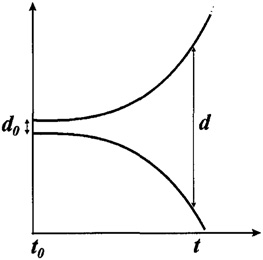 Fig. 4.22: Schematic illustration of the exponential dependence on initial conditions.
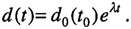
 The dependence of the distance d between two trajectories upon time t, as well as their initial separation d 0 at t= t 0, is assumed to be governed by the exponential function
Exponent denoted ? is an indicator of the sensitivity to small perturbations of initial conditions, and is referred to as Lyapunov exponent. It may be expressed in the form
| (4.5) | 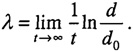
|
If ?>0, the trajectories move apart from each other (as in Figure 4.22); otherwise, if ?<0, the trajectories converge.
Mathematics proves that our system possesses three Lyapunov exponents (the phase space is three-dimensional). At the same time, since we deal with a damped (dissipative) system, the following condition is satisfied
We define the motion as chaotic if at least one of the Lyapunov exponents is positive. If ? 1>0, two other exponents satisfy the condition ? 2+ ? 3<0 (see references [9, 11, 13, 32]).
Thus, the trajectories of chaotic motion do not escape to infinity but preserve a recurrence property. They move apart from each other, and then converge...


 TABLE OF CONTENTS