Chaos, Bifurcations And Fractals Around Us: A Brief Introduction, Series A, Vol. 47

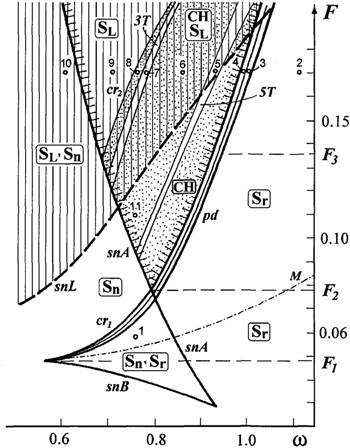
Let us observe regions of existence of different attractors in a wide range of forcing parameter F, satisfying the condition F> F 2 (Figure 4.18). The V-shaped region mentioned in the previous section, where no single-well oscillating attractors exist, is denoted CH. There is a new attractor, denoted S L that appears in this region.
First we observe the steady-state oscillations inside the V-shaped region, prior to the appearance of the attractor S L. We begin with the bifurcation diagram for F=0.11 with decreasing driving frequency ? Figure 4.19. The initial value of frequency satisfies the relation
, thus the diagram starts from the T-periodic resonant attractor in either left (
) or right (
) potential well (
in Figure 4.19). With the decrease of frequency, the resonant attractor undergoes a cascade of period doubling bifurcations, and is transformed into a chaotic oscillating attractor, the attractor that occupies a relatively small range of displacement x p within the potential well. The chaotic attractor exists, however, in a very narrow zone of frequency ?, and it suddenly disappears being replaced by a new form of motion that spreads over both potential wells. In the bifurcation diagram, this motion is illustrated by a wide dark band that covers the displacement range