Controlled Growth of Nanomaterials

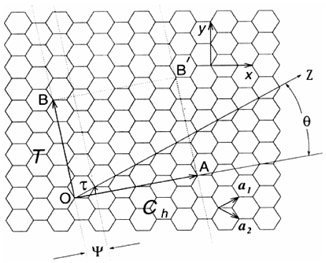
The carbon nanotube which is formed by rolling the graphite sheet has a seamless tube structure.1 Figure 6.1 is the structure model, in which a 1 and a 2 are the unit vectors of the two-dimensional lattice of a nanolayer of graphite, and O is the origin. The OAB'B rectangle on the graphite sheet can be rolled up through the overlapping of O with A and B with B' to form the carbon nanotube. Two ends of the carbon nanotube are often closed by half a fullerene sphere. The axis of this carbon nanotube is parallel to OB, and the circumference length is OA. This carbon nanotube can be represented by a vector C h (the connective line of O and A).
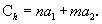
| (6.1) | |
Here, both m and n are integers, and they can be used to characterize the structure of carbon nanotubes. The diameter d 1 of carbon nanotubes and the chiral angle ? which is the angle formed from C h and a 1 are also often used to characterize the structure of carbon nanotubes. The parameters, including C h, m, n, ? and d l, can be related by the following expressions:
| (6.2) | |
| (6.3) | |
where, a c-c is the neighboring carbon atom distance on the graphite sheet.
The carbon nanotubes include single-walled...